
Under the Snow: The Science of Winter Putting Green Survival
By: Andrew Gyba, Golf Course Superintendent, Glen Abbey Golf Club

It is the middle of February, and all is well at the golf course. The greens remain healthy and well insulated, with no ice buildup. There is some freezing rain forecasted in the near future, and it has gotten me thinking about winter putting green management and an old article I wrote a few years back. This information is just as relevant today as it was then, so for those of you who missed it when it was originally published, please continue reading below as I explore the causes of winter injury on putting greens and what your turf crew does on a day-in and day-out basis over the winter months to manage the greens.
Winter Management of Putting Greens in Southern Ontario (originally published in 2022)
To many golfers, winter is a time to reflect and prepare for the upcoming season. Perhaps you find yourself working on your game at indoor simulators or practice areas. Perhaps you find yourself down South enjoying the warmer weather and beautiful golf courses in states like Florida, Arizona, or Nevada. Or perhaps you simply hang up the clubs until the weather thaws and the grass greens up again. Wherever you may find yourself in the off-season, rest assured that your superintendent is still managing your golf course. Even in the dead of winter.
There are many risks to our golf course over the winter months. Unfortunately for us in Southern Ontario, the effects of climate change only exacerbate those risks. We once could plan on a gradual cool-down leading to a freeze, followed by stable temperatures, a constant blanket of snow, and a gradual, consistent warm-up in the spring. That is simply no longer the case. In modern times, snow is scarce and temperatures fluctuate greatly. With this comes the risk of winter kill.
Let’s examine the phenomena that can damage our turf, specifically our greens, through the winter months.
Anoxia Due to Prolonged Ice Cover
A very real risk in modern times is the development of ice cover on greens. Not that it was never an issue in the past — it is just much more prevalent today. As superintendents, we hope for stable temperatures through the winter months and ideally a 30 cm blanket of snow. The benefit of a 30 cm blanket of snow is that, even if it is -40°C above it, the temperature beneath will remain a stable 0°C. Absolutely ideal for winter turf survivability.
When temperatures fluctuate over the winter months, especially when a snow blanket is in place, that snow can begin to melt and refreeze into ice underneath the blanket. An even worse scenario is rain falling on top of a snow blanket and then refreezing. Snow is an excellent insulator and still allows the plant to breathe.
Remember, the turf is dormant, not dead. There are still many processes happening within it through the cold of winter. When ice forms over our greens, it seals off the turf from the atmosphere, restricts gas exchange, and traps dangerous off-gases such as methane. This can lead to death after prolonged exposure.
The two main types of turf found on our greens are bentgrass and Poa annua. Bentgrass can typically survive under ice cover for 90 days; however, Poa annua will only survive under ice for 45–60 days. If a green were to develop an ice layer in December, January, or even early February, turf damage becomes a real risk.
Superintendents are constantly monitoring their greens throughout the winter months to measure snow cover depth and check for ice development. We employ several strategies to combat ice development, including:
1. Late fall deep tine aeration: Also an incredibly beneficial practice for the turf come spring, Deep Tine aeration will plunge solid tines anywhere from 10” – 16” into the green. The hope is that on warmer days melting ice will have a less restricted path to sub drainage. These channels also provide more airspace for the accumulation of off gases in the event an ice layer develops.
2. Boring to drainage: Much like deep tine aeration, experienced superintendents will know which areas of their greens tend to ice over first. These areas are typically found in low lying areas. With this procedure a putting green hole cutter is used to bore down 30 cm – 45 cm to the subdrainage, again in hopes of giving melting ice a clear path to drainage.
3. Eliminating collar dams: Believe it or not, the minute height difference between the fringe collar and the putting green is enough to allow flowing water to stop and freeze during a rain on snow event. Superintendents will identify these areas and sod cut sections of their collars out in hopes to give water an unobstructed path off the green surface.
4. Snow removal: In some situations superintendents may choose to remove snow from their greens by either shoveling or snow blowing. Consider it a preventative measure. If the forecast presents a risk of ice development, say 15 mm of rain on top of 20 cm of snow followed by a freeze. Some superintendents may choose to remove the snow to allow the rain to flow off the greens and lower the risk of ice development. This is a risky option though, considering the insulating blanket one had just removed.
5. Black Sand/Mulch/Organics: In the event of an ice layer developing the decision needs to be made if it should be removed. Typically, snow will be removed and layers of either black sand, mulch, roasted sunflower seeds or other dark-colored organics will be applied to use the warming power of the sun to melt through the ice. Unfortunately, this practice will only work to a maximum of -2⁰C. There are no ice melters or salt compounds commercially available that are safe for use on putting greens.

Desiccation and Low Temperature Injury
Although they are two different mechanisms of injury, winter desiccation and low-temperature injury occur for the same reason: a lack of snow cover.
Winter desiccation is very similar to drought damage. As mentioned before, the turf is alive and dormant, not dead. Water is still required within the plant. Desiccation occurs when turf is exposed to strong winter winds for prolonged periods. Essentially, moisture is drawn out of the plant, leaving it in a state very similar to drought damage.
Low-temperature injury is exactly as it sounds. When insulating blankets of snow are scarce and turf is exposed to temperatures below -15°C for prolonged periods, death can occur. This is much less prevalent in bentgrass and is more often seen in Poa annua. Typically, the risk of damage by this method is lower in the earlier weeks of winter and increases exponentially as spring approaches and the plant tires from a long winter.

Superintendents can employ insulating covers in regions that are prone to desiccation and low-temperature injury. However, this is not a one-size-fits-all remedy and can cause more problems in regions where temperatures fluctuate above and below 0°C throughout the winter.
Crown Hydration
Crown hydration is one of the least understood, most destructive, and least preventable forms of winter kill a golf course superintendent and membership can experience. It mainly occurs during the 2–3 week snowmelt period in early spring.
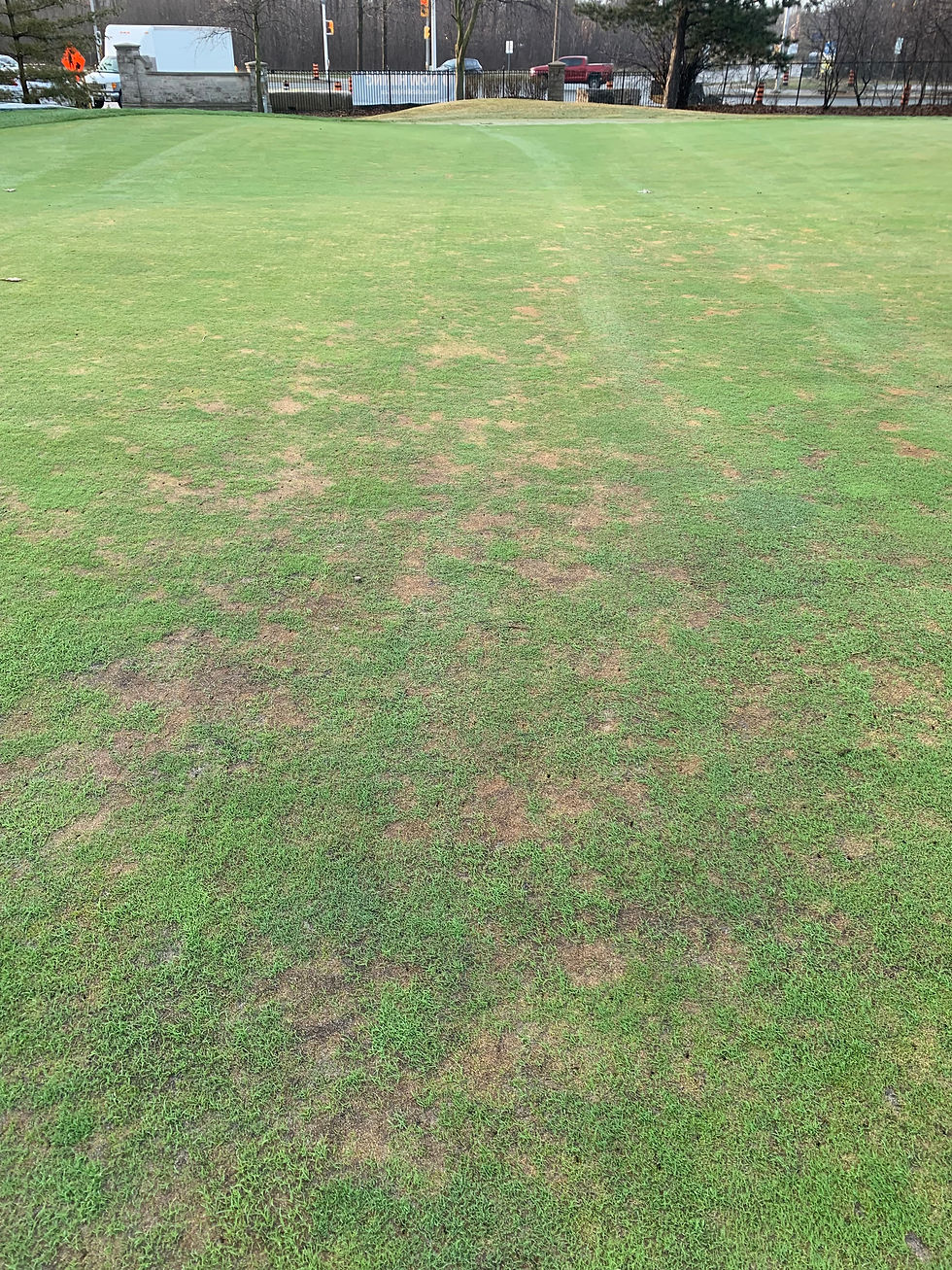
At this time, it is common to find the soil profile still frozen or semi-frozen from a long winter. As the sun shines and temperatures rise on occasional spring days, soils thaw from the surface down. Coupled with surrounding snowmelt, soils become completely saturated and unable to drain because they remain frozen below.
What happens next is that certain species of turf, particularly Poa annua, which many of our greens are predominantly composed of, can break dormancy or “wake up,” thinking spring has arrived and it is time to start growing. These turf plants are relatively weak after a long winter, having used up most of their stored carbohydrate (food) reserves. The first thing they do is begin to take up water.
As we all know, temperatures can fluctuate greatly in the spring. It is not uncommon for temperatures to hover around the freezing mark, then warm to 10–12°C for a day or two, followed by another cooldown. This is where the danger lies. If weak turf plants have been “tricked” into breaking dormancy and begin to take up water, a sudden freeze event can cause the waterlogged cells of the plant to rupture, resulting in death.
A common example of this phenomenon is placing an unopened soda can in the freezer. Just like plant cells, the soda can is filled with liquid and gases, and when it is rapidly frozen, the can ruptures.
Typically, rapid freeze events carry a higher risk of damage than more gradual changes in weather. For example, if daytime temperatures reached 10–12°C for two days and were followed by a drop to -5°C or -10°C that night, I would be very concerned. However, if those two warm days were followed by a 5°C day, then a 2°C day, and finally freezing weather, I would be less concerned.
As you can see, managing putting greens is truly a year-round endeavor. So the next time you notice the forecast change or the weather become extreme over the winter months, remember your turf staff are diligently monitoring conditions and working to ensure excellent putting surfaces, even in the middle of winter.


Comments